
Choosing among standard photo print sizes available online in India is easier when you look beyond the numbers on a product page. A 4 × 6-inch print, an 8 × 10-inch frame print, and a 12 × 18-inch wall print may all use the same photo, but they have different proportions, crop needs, and quality requirements.
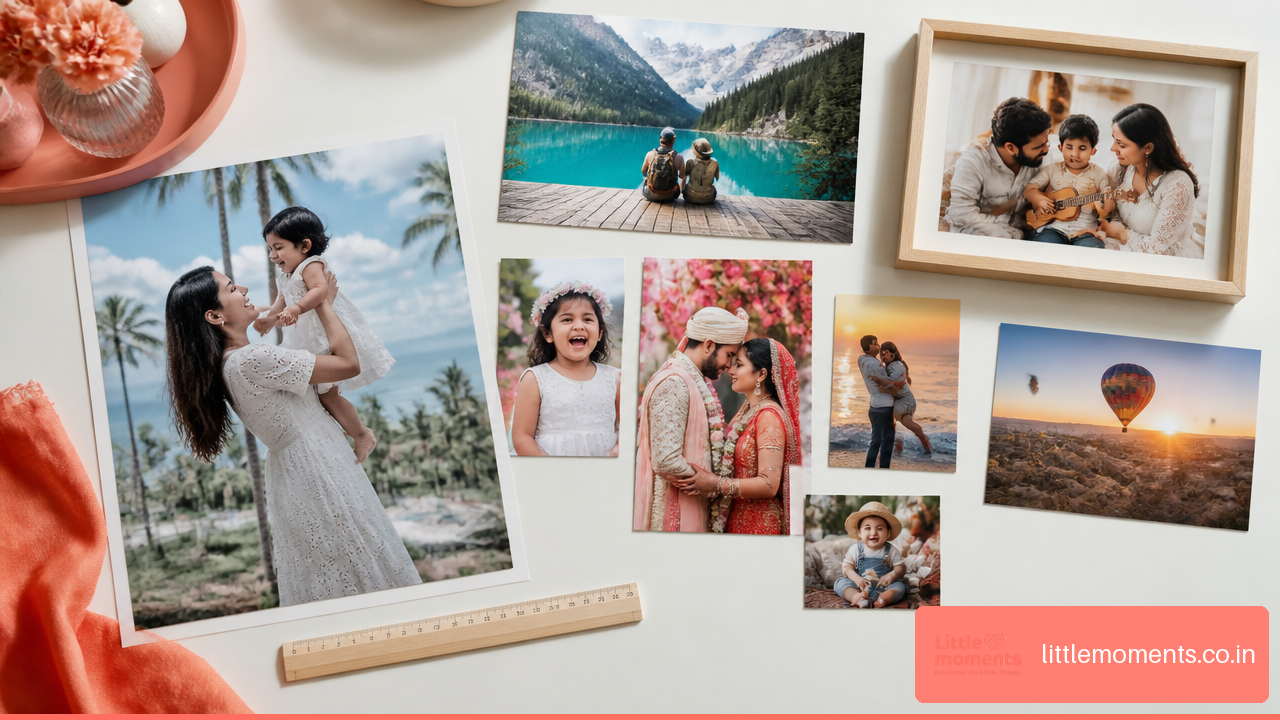
The right size depends on where the print will go, how much of the original photo you want to keep, and whether you are printing on photo paper, canvas, acrylic, or as part of a framed product. We will break down the common choices so you can order with fewer surprises.
Table Of Contents
• Common photo print sizes and where they fit
• Aspect ratio, cropping, and image resolution
• Photo paper, frames, canvas, and specialty formats
• Key takeaways before ordering online
• Frequently asked questions
Common Photo Print Sizes Available Online In India
There is no single nationwide catalogue that every online printer follows. Still, certain dimensions appear often across Indian photo-printing services. The most widely recognized choices are 4 × 6, 5 × 7, 8 × 10, 8 × 12, 12 × 16, and 12 × 18 inches.
A useful rule is simple: choose small sizes for albums and sharing, medium sizes for desks and frames, and larger sizes for walls. Then check the crop preview before paying.
Popular Rectangular Print Sizes
The table below shows commonly listed sizes in both inches and centimeters. Centimeter conversions are approximate, which matters if you are buying a ready-made frame with metric measurements.
Print Size In Inches | Approximate Size In Centimeters | Aspect Ratio | Typical Use |
|---|---|---|---|
4 × 6 | 10.2 × 15.2 cm | 2:3 | Albums, keepsakes, small gifts |
5 × 7 | 12.7 × 17.8 cm | 5:7 | Portraits, greeting-card gifts, small frames |
6 × 8 | 15.2 × 20.3 cm | 3:4 | Desk frames and portraits |
8 × 10 | 20.3 × 25.4 cm | 4:5 | Framed photos and desk display |
8 × 12 | 20.3 × 30.5 cm | 2:3 | Landscape images and wall frames |
10 × 12 | 25.4 × 30.5 cm | 5:6 | Family portraits and medium display prints |
12 × 16 | 30.5 × 40.6 cm | 3:4 | Medium wall frames |
12 × 18 | 30.5 × 45.7 cm | 2:3 | Wall display and larger landscape photos |
18 × 24 | 45.7 × 61 cm | 3:4 | Statement wall art |
24 × 36 | 61 × 91.4 cm | 2:3 | Posters and large wall décor |
Commonly available sizes include 4×6, 5×7, 8×10, 8×12, and 12×16 inches. Note that some printers or frame listings may show dimensions in reverse order (such as 6 × 4 instead of 4 × 6)—the physical print remains identical; only the orientation preference changes.
Small Prints For Albums, Gifts, And Everyday Memories
A 4 × 6-inch print is the familiar album-style format. Its 2:3 proportion is close to photos from many digital cameras and some phone camera modes, so it can be a practical choice when you want less cropping. It is small enough to print several pictures from a trip, birthday, or family event without needing a large storage box or wall space.
For compact memory sets, 4×6 photo prints are a useful starting point when you want an easy, familiar format for albums, scrapbooks, and sharing with family.
A 5 × 7-inch print gives a little more presence without becoming a wall print. It works well for one favorite portrait, a couple photograph, or a small frame on a shelf. Fair warning: it does not share the same proportions as 4 × 6. If your image was tightly composed for a 4 × 6 crop, a 5 × 7 version may trim more from the left and right or top and bottom.
Medium And Large Sizes For Frames And Walls
An 8 × 10-inch print is one of the most familiar frame-oriented sizes. Its near-square 4:5 ratio makes it suitable for portraits, but it can crop a wide landscape photo more heavily than an 8 × 12 print. If the subject fills the frame, use the preview carefully.
For photos with wider composition, 8 × 12 and 12 × 18 are often safer because both use a 2:3 ratio. A beach horizon, wedding venue, group photo, or mountain view usually feels more natural in these wider proportions.
Very large formats deserve a different decision process. A 24 × 36-inch print can make a strong feature wall piece, but the image should be sharp enough and viewed from an appropriate distance. A photo that looks fine on a phone can reveal blur, noise, or heavy compression when enlarged.
Aspect Ratio, Cropping, And Photo Quality
The physical size is only half the decision. Aspect ratio is the width-to-height relationship of a photograph. When your photo and your chosen print have different aspect ratios, the printer must either crop part of the image or leave white borders.
Why A Photo Can Be Cropped Even When It Looks Fine On Your Phone
Many phone photos use a 4:3 ratio by default. That is different from a 4 × 6 or 12 × 18 print, both of which use a 2:3 ratio. A 4:3 image placed into a 2:3 print area is wider relative to its height than the print area. To make it fill the paper without borders, the ordering tool may cut off a portion of the top and bottom.
Here is how common proportions compare:
Photo Or Print Format | Ratio | Crop Risk When Matched To |
|---|---|---|
Many phone camera photos | 4:3 | 4 × 6 or 12 × 18 prints |
4 × 6 and 12 × 18 | 2:3 | 5 × 7, 8 × 10, and 12 × 16 prints |
5 × 7 | 5:7 | Most camera-native formats |
8 × 10 | 4:5 | Wide landscape photos |
Square prints | 1:1 | Portrait or landscape photos |
Suppose you have a family group photo with people standing close to both edges. An 8 × 10 print may cut shoulders or hands if the original is wide. In that situation, choose an 8 × 12 print, use a white border, or edit the image onto a larger blank canvas before uploading. The best option is the one that protects the people and details you care about.
Always treat the crop preview as part of the order, not as a final formality. Check faces, hands, text, horizons, and objects near every edge.
For a detailed breakdown of resolution requirements (like target pixel dimensions) across standard rectangular and square sizes, see Squared.one’s standard photo print size guide.
A Practical Pixel Checklist
Print quality depends on the photo’s pixel dimensions, not only its file size in MB. A common planning benchmark is 300 pixels per inch, often written as 300 PPI. It is a helpful target for close-viewed photo prints, though some images can still look acceptable at lower resolution depending on the printer, paper, image detail, and viewing distance.
Print Size | Suggested Pixel Dimensions At 300 PPI | Best Use |
|---|---|---|
4 × 6 | 1200 × 1800 pixels | Albums and small prints |
5 × 7 | 1500 × 2100 pixels | Small frames and gifts |
8 × 10 | 2400 × 3000 pixels | Frames and desk displays |
8 × 12 | 2400 × 3600 pixels | Landscape prints |
12 × 16 | 3600 × 4800 pixels | Medium wall prints |
12 × 18 | 3600 × 5400 pixels | Large framed prints |
24 × 36 | 7200 × 10800 pixels | Large, close-viewed prints |
These numbers are guidelines rather than a universal guarantee. For example, a clean photo from a recent phone may look pleasing at 12 × 18 even if it falls short of 3600 × 5400 pixels. A heavily edited social-media download may look soft at the same size because it has been compressed.
For a reference on matching digital pixel dimensions to physical print formats before editing, you can check PicMonkey’s photo print sizing guide.
How To Protect Important Details
Before upload, keep the original image whenever possible. Avoid screenshots, images forwarded repeatedly through messaging apps, or photos downloaded from a social platform when you have access to the original camera file.
Use this simple sequence:
Open the original full-resolution image.
Select the print size before doing major edits.
Crop with enough room around faces, hair, hands, and text.
Review the print tool’s preview at each edge.
Choose borders if the alternative is losing an important part of the photo.
Borderless printing can look neat, but it may require a slight overscan at the edge. That means a tiny amount of image area can be lost even after you have selected a crop. Keep critical details slightly inside the edge rather than placing them flush against it.
Photo Paper, Frames, Canvas, And Specialty Formats
“Photo print size” can mean different things online. A loose photographic print, framed print, canvas, acrylic panel, and poster may share a listed dimension, yet they are not interchangeable products.
Loose Prints Are Not The Same As Framed Or Mounted Prints
A loose photo print is paper-based and usually intended for an album, frame, scrapbook, or direct display. The listed size commonly refers to the actual printed sheet.
A framed product includes a border, mount, or frame structure, so the outside dimensions can be larger than the printed photo. If you own an 8 × 10-inch frame, confirm whether it accepts an 8 × 10 image directly or requires a smaller print with a mat.
Canvas and acrylic products also change the visual result. Canvas has texture and may wrap around the sides of a stretcher frame. Acrylic offers a glossy, rigid presentation. Posters may be printed on a different material than photographic paper. Choose based on location and finish preference, not simply because the dimensions match.
Specialty formats often separate standard silver-halide prints, Polaroid-style layouts, square formats, phone-case prints, and large-format wall art into distinct categories—a helpful reminder that what is considered “standard” varies depending on the product type.
Square And Polaroid-Style Prints
Square prints are a natural fit for social-media images, which are often composed in a 1:1 format. Common choices include 3.5 × 3.5 and 8 × 8 inches, although availability differs between providers.
Polaroid-style products are usually not just square photos. They often include a wider white lower border, creating space for a date, short note, or handwritten message. This makes them especially useful for memory walls, birthday gifts, and scrapbook pages. If you prefer that instant-photo look, polaroid photo prints provide a different layout from a standard borderless print.
A4, A3, And 12 × 18 Are Different Dimensions
A4 and A3 are ISO paper sizes, while 12 × 18 is a photographic size. They are close enough to be confused, but they are not identical.
Format | Dimensions In Inches | Approximate Dimensions In Centimeters | Ratio |
|---|---|---|---|
A4 | 8.27 × 11.69 | 21 × 29.7 cm | About 1:1.41 |
A3 | 11.69 × 16.54 | 29.7 × 42 cm | About 1:1.41 |
12 × 18 | 12 × 18 | 30.5 × 45.7 cm | 2:3 |
An A3 frame will not fit a 12 × 18-inch print neatly, and a 12 × 18 crop will not naturally match an A3 sheet. Many print services offer both A4 and 12 × 18-inch options, illustrating why shoppers should double-check exact measurements rather than assuming these labels are equivalent.
Passport And Visa Photos Need Extra Care
Passport and visa photo products should not be selected by size alone. Requirements can vary by the country or authority reviewing the application. The correct dimensions, background color, head size, facial position, eyewear rules, and photo age may all differ.
Use the official instructions for the destination authority first. Then choose an online photo product only if its specification matches those requirements. A standard portrait print is not automatically acceptable for an identification application.
Ordering Standard Photo Prints Online With Confidence
Online printing is convenient because you can upload from a phone, crop, choose a finish, and place an order without visiting a shop. The stronger approach is to decide on your intended display before selecting the product page.
Match The Size To The Final Use
Use this quick decision table when you are unsure where to begin.
Need | Good Starting Size | Consider Avoiding |
|---|---|---|
Photo album or scrapbook | 4 × 6 | Large wall sizes that are hard to store |
Small desk frame | 5 × 7 or 8 × 10 | Wide 12 × 18 prints unless the frame supports them |
Family wall frame | 8 × 12, 12 × 16, or 12 × 18 | 8 × 10 if a wide image would crop heavily |
Square memory wall | 3.5 × 3.5 or 8 × 8 | Rectangular prints if consistency matters |
Large décor piece | 18 × 24 or 24 × 36 | Low-resolution screenshots or compressed downloads |
Sentimental gift set | Small prints or Polaroid-style prints | One oversized print when several memories tell the story better |
For a broad starting point, the photo prints collection can help you compare formats before you settle on one size.
Glossy Or Matte: Choose For The Room
Glossy paper generally has a reflective surface and can make colors appear more vivid. It can suit photos with rich color, such as travel scenes, celebrations, and outdoor images. Its trade-off is glare under direct lights and more visible fingerprints.
Matte paper has lower reflection and is often easier to view under bright room lighting. It can be a sensible option for framed portraits, images with text, or prints handled often. Matte may look less shiny, but that is not a quality problem. It is a finish preference.
Check These Details Before Checkout
A few minutes of review can prevent an order that does not suit your image or frame.
Confirm whether the size refers to the photo area, paper, or finished framed product.
Rotate the image between portrait and landscape if the tool allows it. The same 8 × 10 dimensions can produce a very different crop in each orientation.
Check whether the preview fills the entire sheet or adds borders.
Look closely at faces, hands, captions, date stamps, and horizon lines near the edge.
Review the selected paper finish, quantity, and shipping details before checkout.
Key Takeaways
What To Remember Before You Print
• 4 × 6 inches remains one of the most useful small print sizes for albums, keepsakes, and sets of photos.
• 5 × 7 and 8 × 10 inches work well for small frames, but their aspect ratios may crop wide camera photos.
• 8 × 12 and 12 × 18 inches share a 2:3 ratio, making them practical choices for many wide compositions.
• 12 × 18 is not the same as A3, even though both are often used for larger prints.
• A 300 PPI pixel target is a practical quality benchmark, but the final result also depends on image sharpness, compression, paper, and viewing distance.
• Always check the crop preview, especially when people, text, or important objects are close to the edge.
• Loose photo prints, framed prints, canvas, acrylic, and posters can have similar dimensions but serve different display needs.
Frequently Asked Questions
What Are The Most Common Photo Print Sizes Available Online In India?
The most commonly listed sizes include 4 × 6, 5 × 7, 8 × 10, 8 × 12, 12 × 16, and 12 × 18 inches. Larger sizes such as 18 × 24 and 24 × 36 are also available from some providers. Availability varies by product category and printer.
Is 4 × 6 Inches The Usual Album Photo Size?
Yes. A 4 × 6-inch print is a widely used small photo format for albums, scrapbooks, and everyday prints. Its 2:3 ratio may also suit many camera photos better than squarer frame sizes.
What Is The Difference Between 4 × 6, 5 × 7, And 8 × 10 Prints?
The main differences are physical size and aspect ratio. A 4 × 6 uses 2:3, a 5 × 7 uses 5:7, and an 8 × 10 uses 4:5. Moving to a larger size makes a photo more visible, but changing ratios can crop different parts of the image.
Which Photo Size Is Best For A Standard Frame?
An 8 × 10-inch print is a common choice for a desk or tabletop frame. For a wider photo, consider 8 × 12 instead. Check the frame’s exact opening before ordering because a mat board can change the required print size.
Why Does My Image Get Cropped When I Order A Standard Print?
Cropping happens when the aspect ratio of your photo does not match the aspect ratio of the print. The ordering tool enlarges the photo to fill the selected area, which can cut off edges. Use the crop preview, pick a closer matching size, or select borders where available.
Are Square Photo Prints Available From Indian Online Printers?
Yes, square formats are available from some services, though the exact dimensions vary. Smaller square prints can suit memory walls and gift sets, while 8 × 8-inch prints work well for framed social-media-style photos.
Can I Order Custom Photo Dimensions Instead Of Standard Sizes?
Some printers offer custom dimensions or large-format options, but this is not universal. If you need an unusual measurement, confirm the finished size, print material, orientation, and whether the printer will crop or add borders before ordering.
Are Passport And Visa Photo Sizes The Same Everywhere?
No. Passport and visa requirements can differ by destination authority. Check the official requirements for the application you are submitting, including dimensions, background, head position, and other rules, before ordering any identification-photo product.