
Hundreds of photos sit in your phone, and almost none of them get seen. Printing a few and putting them where you’ll walk past them every day changes that. This guide covers 15 easy ways to display photo prints at home, from gallery walls and string lights to fridges, shelves and albums, with the right print size for each spot.
Table Of Contents
- Before You Start: Pick Your Photos
- 15 Creative Ways To Display Photo Prints
- Which Print Size For Which Spot
- Ideas Room By Room
- Displaying Photos In A Rented Home
- Tips To Keep Prints Looking Good
- Frequently Asked Questions
Before You Start: Pick Your Photos
A display looks planned when the photos belong together. Before you print, pick a theme: one trip, one year, the kids growing up, or the family across generations. Then:
- Choose 8 to 20 photos for a wall or string lights, and 1 to 3 for a shelf or desk.
- Use the original files from your phone’s gallery. Photos saved from WhatsApp or social media are compressed and print blurry.
- Keep the editing consistent. All colour, all black and white, or all warm tones makes a mixed set look like a collection.
- Mix close-ups with wider shots, so the display has a few faces you can see from across the room.
15 Creative Ways To Display Photo Prints
1. A Gallery Wall
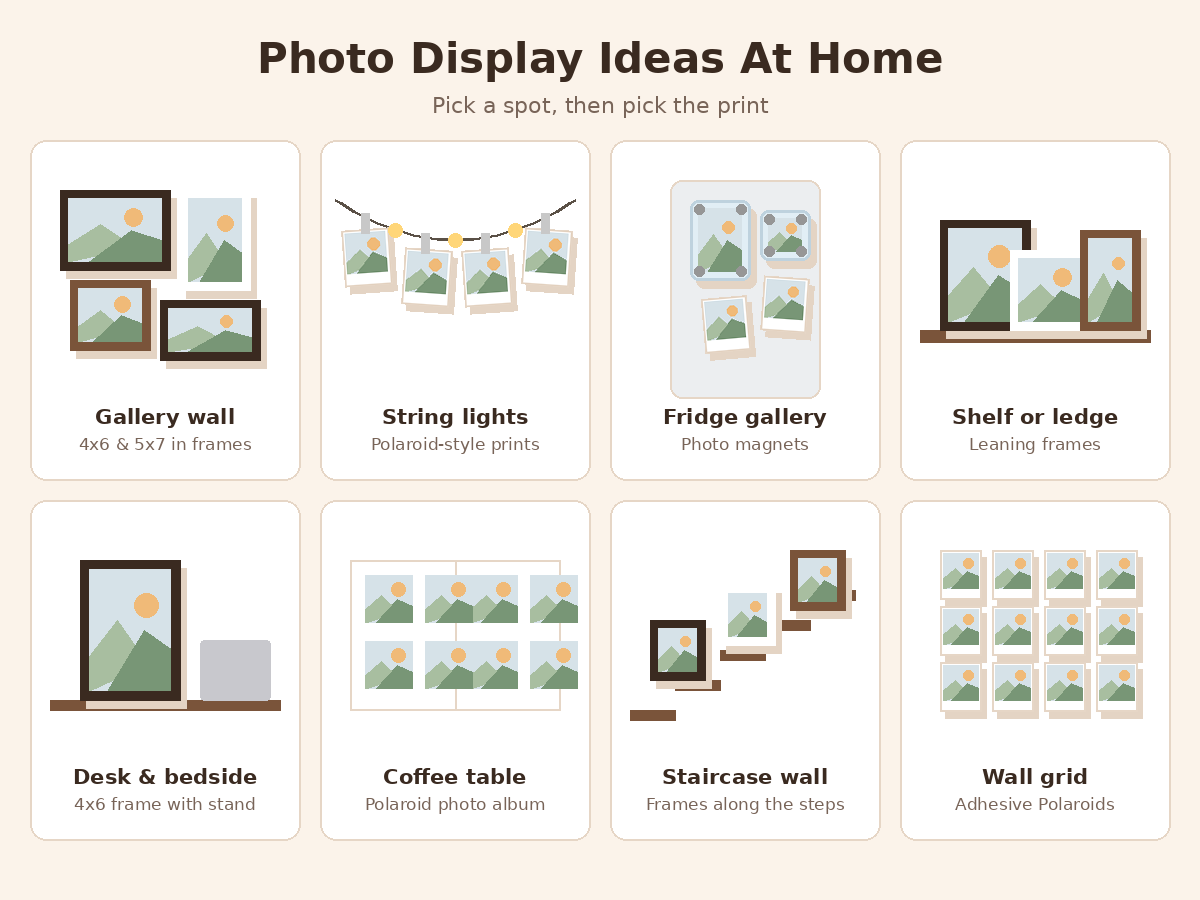
The classic. Group several framed prints on one wall, with even gaps of about 5 to 8 cm between frames. Lay the arrangement out on the floor first, or tape paper cut-outs to the wall, before you hammer a single nail. Matching frames look calm and tidy; mixed frames look relaxed and collected.
2. Polaroid Prints On String Lights
The most popular display for bedrooms and study corners. Clip Polaroid photo prints to LED photo string lights with clips and drape them across a wall, a headboard or a window. The set has 14 transparent clips and warm white lights that plug straight into a socket, so there are no batteries to change.
3. A Polaroid Grid
Stick adhesive Polaroid photos in a neat grid, for example 4 across and 4 down. A tight grid of 16 small photos makes a bold, graphic feature on a plain wall, and works well above a desk or bed.
4. The Fridge Gallery
The fridge is the most-viewed “wall” in most Indian homes. Polaroid photo fridge magnets come in sets of 4 to 48, so you can cover a door with a whole year of family moments. For one or two favourites, an acrylic fridge magnet holds the photo behind a clear plate, and you can swap the photo later.
5. A Shelf Or Picture Ledge
If you don’t want to commit to nails, lean frames on a floating shelf or picture ledge. Overlap a few frames of different sizes, and add a plant or a book so it doesn’t look like a row of photos in a shop.
6. Desk And Bedside Frames
A single framed print beside your laptop or bed gets seen more than any wall. A personalised 4×6 photo frame has a built-in stand and a wall hook, so it works on a desk or a wall.
7. Mini Frames In A Cluster
Small frames look sweet in a group of three or five. 3×3 inch and 4×4 inch frames come with an optional easel stand, which suits a TV unit, a pooja room shelf or a dressing table.
8. A Staircase Wall
Stairs are wasted wall space in many homes. Hang frames along a diagonal line that follows the steps, keeping the centre of each frame at roughly the same height above its step.
9. A Hallway Memory Lane
Turn a corridor into a timeline: grandparents’ wedding photo at one end, the newest family photo at the other. Guests stop and look, and children learn the family story.
10. A Rotating Photo Calendar
A custom photo calendar shows a new photo every month, so your display changes on its own. A tabletop calendar suits a desk; a calendar magnet goes on the fridge.
11. A Coffee-Table Album
Not every display has to hang. A Polaroid photo album on the coffee table holds up to 64 photos, with space under each page to write a few lines about the moment. Guests will pick it up.
12. A Photo Strip On The Fridge
Three photos in a row tell a mini story: a date night, a birthday, a day out. An acrylic photo magnet strip holds three photos in a vertical strip, photo-booth style.
13. A Journal Or Scrapbook
Mini prints and adhesive Polaroids go straight into a travel diary or scrapbook, alongside tickets and handwritten notes. Mini Polaroid prints at 5 × 7.5 cm are the easiest size for journalling.
14. A Seasonal Swap
Keep one frame or one string of lights for “this season”: Diwali photos in October, last year’s holiday in summer, the children’s school photos in June. Swapping prints every few months keeps the display fresh.
15. A Themed Corner
Give one shelf or wall a single theme: travel, a wedding or childhood. Add one or two related objects, such as a souvenir or a ticket stub, and the corner tells a clear story.
Which Print Size For Which Spot
| Spot | Best print or product | Why |
|---|---|---|
| Gallery wall | 4×6 and 5×7 prints in frames | Big enough to see from across the room |
| String lights | Standard or large Polaroid-style prints | Light, easy to clip, look good in a row |
| Plain wall grid | Adhesive Polaroids | No frames or nails needed |
| Fridge | Polaroid magnets, acrylic magnets, magnet strip | Built to hold on metal |
| Desk or bedside | 4×6 frame with stand | Readable at arm’s length |
| Small shelf | 3×3 or 4×4 frames | Fit narrow spaces |
| Coffee table | Polaroid photo album | Holds many photos in one place |
| Journal | Mini Polaroid prints (5 × 7.5 cm) | Fit diary pages |
Not sure which size suits your photos? Read our guide to the best photo print dimensions.
Ideas Room By Room
- Living room: a gallery wall above the sofa, an album on the coffee table, mini frames on the TV unit.
- Bedroom: Polaroids on string lights above the bed, one framed photo on the bedside table.
- Kitchen and dining: a fridge gallery with magnets, a family photo near the dining table.
- Kids’ room: an adhesive Polaroid grid of milestones that grows each year.
- Home office: a desk frame and a tabletop photo calendar.
- Entrance and hallway: a memory lane of family photos through the generations.
Displaying Photos In A Rented Home
Many landlords don’t want holes in the walls. These ideas need no nails:
- String lights, hung from existing hooks or curtain rods.
- Frames on shelves and ledges, or standing on furniture.
- Fridge magnets, which leave no mark at all.
- Albums and calendars, which need no wall space.
- Removable wall hooks, sold at hardware stores, for light frames. Test one in a hidden spot first.
Tips To Keep Prints Looking Good
- Avoid direct sunlight. Strong sun fades prints over time, so don’t hang them opposite a sunny window.
- Keep them away from damp walls, bathrooms and kitchen steam, which can curl paper prints.
- Use frames for your favourites. A frame with a clear front keeps dust and fingerprints off the photo.
- Light the display. Warm light in the evening makes a photo wall feel cosy instead of flat.
- Print duplicates of irreplaceable photos and display the copy, not the original.
Got old family photos you’d like to put on display? See our guide to reprinting old photos.
Related reads
- Personalised photo frames for your home
- How to print custom Polaroid photos online in India
- Photo print trends for 2026 and 2027
Frequently Asked Questions
How can I display photos at home without frames?
Clip Polaroid-style prints to string lights, stick adhesive Polaroids in a grid on the wall, use photo fridge magnets, or keep prints in an album on the coffee table. None of these need frames.
How do I display photos without damaging the walls?
Use string lights hung from existing hooks, frames that stand on shelves or furniture, fridge magnets, or removable wall hooks for light frames. These avoid drilling or nails, which suits rented homes.
How many photos should a gallery wall have?
Most gallery walls use 6 to 15 framed photos, depending on the wall size. Above a three-seater sofa, 6 to 9 frames is a good start. Keep gaps of about 5 to 8 cm between frames.
What size photo prints are best for a wall?
For framed walls, 4×6 and 5×7 inch prints are the most common, as they’re easy to see from a few steps away. For string lights and grids, Polaroid-style prints work best.
How do I make a photo display look good?
Pick a theme, keep the editing consistent (all colour or all black and white), use the original photo files, and keep even spacing between prints. Mixing close-ups with wider shots adds variety.
How do I stop photos fading on display?
Keep prints out of direct sunlight, away from damp walls and kitchen steam, and use frames for the photos you care about most. For irreplaceable originals, display a reprint and store the original safely.